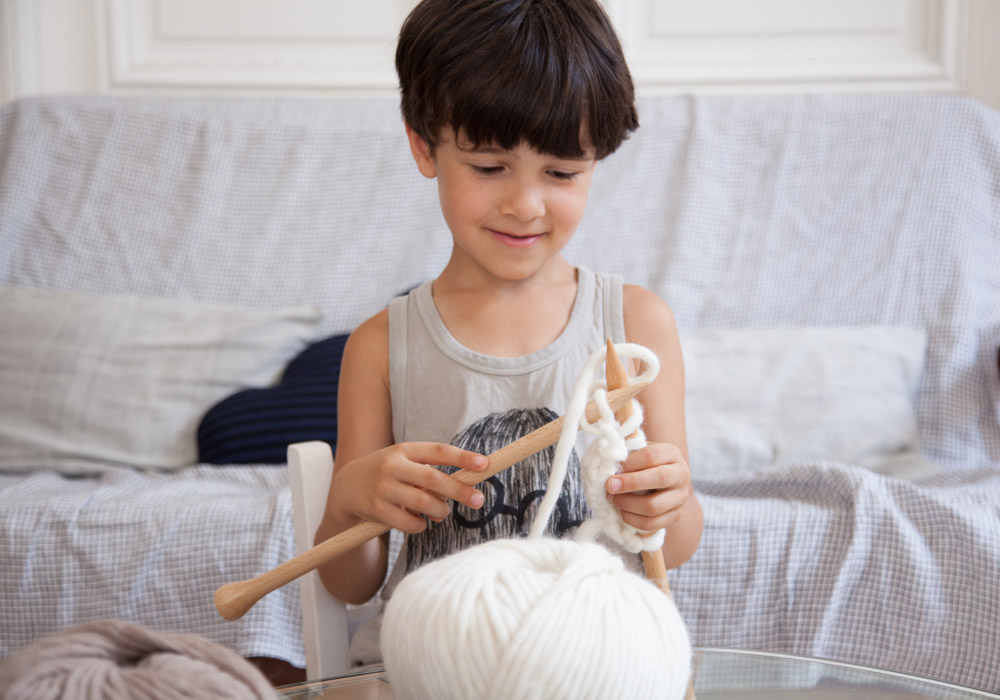
Children often hear “be patient” long before they have something small enough to practise it on. Knitting and crochet give them that missing middle ground, because a scarf, square or wonky chain asks them to slow down, try again and see progress gather in their hands.
These crafts don’t need to be perfect to be worthwhile. A dropped stitch, uneven tension or row that turns out wider than expected can still teach a child that making something takes time, and mistakes can be fixed.
Hands Learn What Words Cannot Always Teach
Working yarn around needles or a hook asks children to coordinate fingers, eyes and movement in a way that feels purposeful. They are pulling loops through loops, counting stitches, noticing tension and learning how a small movement changes the whole piece.
That handwork can help children who rush through tasks or give up when something feels fiddly. Even a few craft materials that support creativity and hand-eye coordination can give children a way to see their effort grow row by row.
Confidence Grows Through Something They Can Hold
A child who has made a bracelet, coaster or blanket for a toy gets proof of their effort. They can point to it and say they made it, even if an adult helped cast on or untangle the wool halfway through.
Shared making can be especially helpful for a child settling into a new home, because it gives them something to do beside an adult without making conversation feel forced. In a household supported by agencies like Foster Care Associates Scotland, wool, a simple pattern and twenty quiet minutes might create an easier opening than direct questions.
What Children Learn While They Make
Knitting and crochet can look like a quiet hobby, but there is a lot going on beneath the surface.
Counting stitches: Children count rows and repeats without feeling like they are doing a worksheet.
Planning a project: They learn that a bigger blanket, scarf or toy accessory needs more yarn, more time and sometimes more help.
Fixing mistakes: A missed loop or tangled ball asks them to pause, look closely and work out what happened.
Thinking about others: Making something for a sibling, friend or grandparent helps them choose colours, sizes and details with another person in mind.
It also gives children a different kind of screen break, with something interesting to do while listening to music, chatting or sitting quietly after school.
It Can Become a Social Skill Too
Some children enjoy learning from a grandparent, neighbour, teacher or older sibling. Others may prefer a small club where everyone is making at their own pace. In either setting, the child sees that adults are learners too, and that a hobby can connect different ages.
Many adults recognise this feeling, with group knitting linked with social contact and communication, and children can feel the same lift from asking, “How did you do that stitch?” or showing a finished square.
Start Small and Keep It Enjoyable
A first project should be short enough to finish before enthusiasm runs out. Finger knitting, a simple crochet chain, a bookmark, a small blanket square or a scarf for a teddy all work better than a full jumper.
Choose thick yarn, larger needles or a hook so the movements are easier to see. Let the child pick a colour, keep sessions short and resist taking over every mistake. If the craft becomes a test, the benefit disappears. If it stays forgiving and repeatable, children learn patience, confidence and creativity through something they can carry or wear.