Introduction
Manufacturing complex industrial components requires a high level of precision, consistency, and quality control. Defects such as cracks, porosity, dimensional inconsistencies, and weak structural areas can significantly affect product performance and operational reliability. This is why Investment Casting is widely used across industries that require accurate and defect-resistant components.
Investment casting allows manufacturers to produce highly detailed parts with strong structural integrity and controlled material distribution. Through carefully managed production processes, manufacturers can significantly reduce the risk of defects while maintaining high levels of precision and consistency.
Companies such as Texmo Blank continue to support advanced manufacturing industries by producing investment-cast components designed for reliability, durability, and high-performance operation.
Precision Mould Design and Manufacturing Control
One of the key advantages of investment casting is the precision of the mould creation process. Detailed wax patterns and carefully engineered ceramic moulds allow manufacturers to achieve highly accurate component geometries with minimal variation.
This precision helps reduce dimensional inconsistencies that may otherwise create fitting issues, operational stress, or premature wear within assemblies.
Controlled manufacturing conditions throughout the casting process also help maintain consistency between production runs, reducing the likelihood of defects caused by process variation.
Accurate mould design is therefore essential for producing complex components that meet strict engineering specifications.
Reducing Porosity and Internal Defects
Porosity is one of the most common concerns in metal casting processes. Air pockets or voids within a component can weaken structural integrity and reduce long-term reliability.
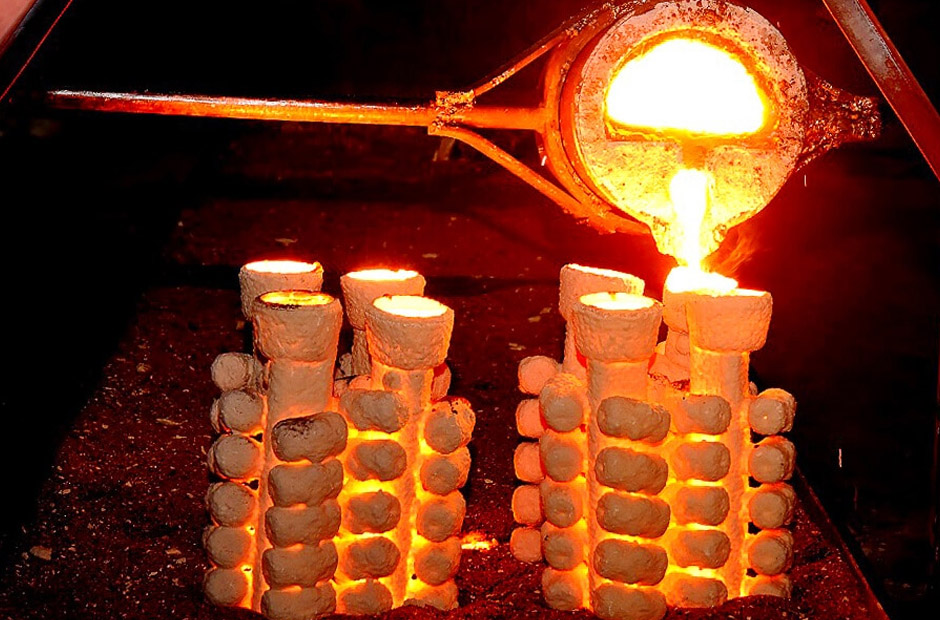
Investment casting minimises these risks by carefully controlling metal flow and solidification during production. The process allows molten metal to fill complex mould geometries more evenly, helping reduce trapped gases and internal inconsistencies.
Advanced process control also improves material density and uniformity throughout the component, resulting in stronger and more reliable finished parts.
Reducing internal defects is particularly important for industries where components operate under high stress or safety-critical conditions.
Improving Structural Integrity
Complex components often contain intricate shapes, thin sections, and detailed features that may be difficult to manufacture using traditional methods without introducing weaknesses.
Investment casting supports improved structural integrity by producing components with smooth material flow and balanced internal structures. This helps distribute stress more evenly throughout the part during operation.
Components with stronger structural integrity are better able to resist fatigue, vibration, and mechanical stress over long operational periods.
This level of reliability is essential within aerospace, automotive, energy, and industrial engineering applications.
Achieving Greater Dimensional Accuracy
Dimensional variation can create assembly problems and operational inefficiencies within complex engineering systems. Components that do not meet precise specifications may require additional machining or rework, increasing production costs and delaying manufacturing timelines.
Investment casting helps minimise these issues by delivering high-dimensional accuracy directly from the casting process. Tight tolerances reduce the need for secondary finishing operations while improving consistency across production batches.
Accurate components fit more effectively within assemblies, enabling smoother installation and more reliable overall system performance.
Supporting Complex Geometries Without Compromising Quality
Modern industrial systems increasingly rely on complex component designs to improve efficiency, reduce weight, and optimise operational performance.
Investment casting allows manufacturers to create intricate shapes and detailed features while maintaining consistent material quality and structural reliability. The process supports complex geometries that may be difficult to achieve using conventional manufacturing methods.
Importantly, this design flexibility does not compromise component integrity. Instead, it enables manufacturers to achieve advanced engineering outcomes while maintaining strong quality standards.
Enhancing Production Consistency
Consistency plays a major role in reducing defects across large-scale manufacturing operations. Components that vary across production runs may pose quality-control challenges and reduce overall operational reliability.
Investment casting supports repeatable manufacturing outcomes through tightly controlled production procedures and detailed process monitoring.
Consistent component quality improves assembly efficiency, simplifies inspection processes, and reduces the likelihood of defective parts entering operational systems.
For industries that produce high volumes of precision-engineered components, this consistency is essential to maintaining production reliability.
Conclusion
Investment Casting plays a vital role in reducing defects within complex industrial components by improving dimensional accuracy, structural integrity, and material consistency throughout the manufacturing process.
Its ability to minimise porosity, support complex geometries, and maintain repeatable production quality makes it an essential solution for modern high-performance engineering applications.
Through advanced precision manufacturing capabilities, Texmo Blank continues to deliver investment-cast components that support reliability, operational efficiency, and long-term industrial performance.