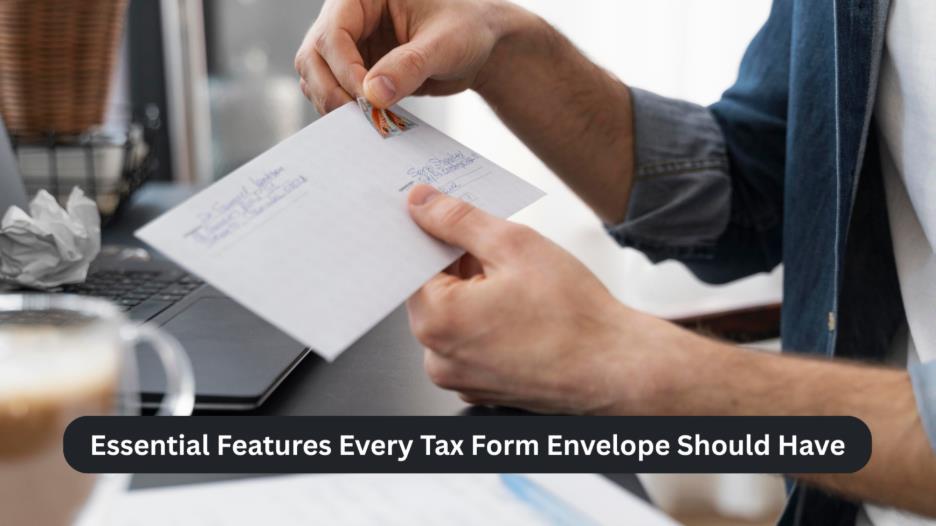
Tax season has a way of tightening your shoulders before you even open the first form. You have to deal with deadlines, document sorting, and hoping none of these things are lost or end up in the wrong hands. One torn envelope, one exposed line of text, or one misaligned window can turn a routine mailing into a privacy nightmare or a rejected submission.
Yet the humble envelope is often the last thing anyone thinks about. It is small when compared to compliance regulations and financial reports, but it is the single point of contact between your confidential data and the external environment. The selection of the appropriate envelope is not merely a final addition, but a security measure.
This is why the choice of the tax envelope is as important as you might suspect. In the following sections below, you will find the key features every tax form envelope should have.
Why Selecting Right Tax Form Envelopes Really Matters?
Millions of tax documents are sent via postal systems every year. In case of an envelope failure, either in the tearing, spilling confidential information, or becoming lodged in an automated sorting machine, your financial information will be compromised. High-quality tax form envelopes ensure privacy, document integrity, and avoids expensive compliance failures.
Features Every Tax Form Envelope Should Have
Before deciding about the kind of envelope to use next tax season, it is good to know the factors that ensure your documents are maintained, in compliance, and ready to be easily processed. The following are the features that have been identified as essential when it comes to protecting sensitive financial information.
1. Strong Security Tinting for Privacy Assurance
The first line of defense of a reliable tax envelope is its internal security pattern, often called “security tinting.” Without it, printed text becomes visible when held against light, a major privacy hazard.
Good security printing does not allow anyone to see information like the Social Security number, employer identification, or earnings information. According to the FTC’s Consumer Sentinel Network Data Book 2023, identity-theft cases linked to stolen or exposed mail continue to be a persistent threat, making robust privacy protection an essential requirement.

2. Durable, High-Quality Paper Stock
Tax forms are either on multiple pages or thick sheet forms. The thinner the envelope, the more chances one has to tear it during the postal machines, or after having been touched in an office. To avoid damage, look for:
- 24 lb. or higher paper weight
- Tear-resistant material
- Reinforced edges that maintain structure
A durable envelope makes sure that your tax information is received perfectly, with no folded papers or loose information.
3. Correctly Aligned Windows for IRS-Approved Forms
Aligning windows appears to be an easy task; however, in the case of tax documents, it is essential. Misaligned window refers to the fact that some important identifiers, like your address or employer details, do not appear properly, causing the chances of late delivery or misplaced mail to be high.
Look for envelopes specifically designed for IRS forms, such as:
- W-2
- 1099 variants
- 1095-C
- 1042-S
Proper alignment keeps you compliant and avoids rejected submissions.
4. Easy, Secure Sealing Options
Tax season typically implies mass mailing, and efficiency and a powerful seal are significant. Your desired envelopes are those that can be closed fast yet sealed in transit. Popular sealing choices include:
- Self-seal adhesive: Fast and mess-free
- Peel-and-seal strips: Best for bulk office use
- Traditional gummed flaps: Tamper-evident when moistened
A secure seal assists in reducing potential cases of document tampering or missing.
5. Printers and Mailing Compatibility
A lot of firms are using automated processes in stuffing, sealing, and sorting tax envelopes. Envelopes, therefore, should be compatible with:
- Laser and inkjet printers
- Pressure-seal machines
- High-speed mail inserters
Using envelopes that are made to fit office equipment minimizes the amount of jam in the paper and improves the accuracy of the mail.
6. Additional Safety of Tamper-Evident Construction
Some envelopes have tamper-evident properties, which indicate whether one is trying to open it prior to the recipient receiving it or not. These features may include:
- Void-pattern closures
- Strong adhesive zones
- Reseal-proof flaps
Such protection measures strengthen trust and assure the client or the staff that their confidential data is safe during the mailing procedure.

7. Recyclable and Environment-Friendly Solutions
As sustainability is now an issue for the people and the business world, the majority of the suppliers have brought about recyclable, biodegradable or sustainably sourced envelopes. An environmentally friendly envelope enables you to:
- Lessen your impact on the environment
- Conform to business sustainability
- Keep the security and quality at the same level
Even slight variations create long-term variations, particularly when sending hundreds of forms every year.
8. Branding and Organization Customizable Printing
Customization not only concerns aesthetics but also facilitates managing mail and professionalism of the brand. You can add:
- Company logos
- Return addresses
- Color-coding for departments
- Guidelines for the recipients
- Batch numbers
Correct labelling also minimizes the chances of mismatched documentation, which is of particular concern to large companies that deal with a variety of tax types.
9. IRS-Compliant Dimensions and Layout
The quality of tax envelopes must be of a standard depending on the shape that the envelope is going to be executed. When non-compliant envelopes are used, this would lead to:
- Returned mail
- Mis-delivery
- Incorrect document folding
- Delays in employee filing
Never forget to check whether your envelopes are the right size and the position of the window as required by the IRS. Most manufacturers write about the size of the envelope, so one can easily select the right one.
10. Cost-Effective Buying Options Without Compromising Quality
It is hard not to replace more expensive envelopes with cheaper ones, yet the poorer the quality of the envelope, the more expensive it is to lose or have a delay in processing. Instead, consider:
- Buying in bulk
- Selecting mixed packs designed for multiple form types
- Choosing mid-tier options with essential features
This approach lets you balance cost and reliability, especially during peak tax seasons.
Final Thoughts
The use of tax envelopes may be viewed as a minor point, yet an important one in making the tax season safe, accurate, and professional.
With an emphasis on such aspects as durability, security tinting, compatibility with equipment, and proper alignment, you can secure your financial information and minimize the risks of compliance.
The right tax envelope will make a substantial difference, whether you are filing on your own, or you are a company handling hundreds of employee forms.