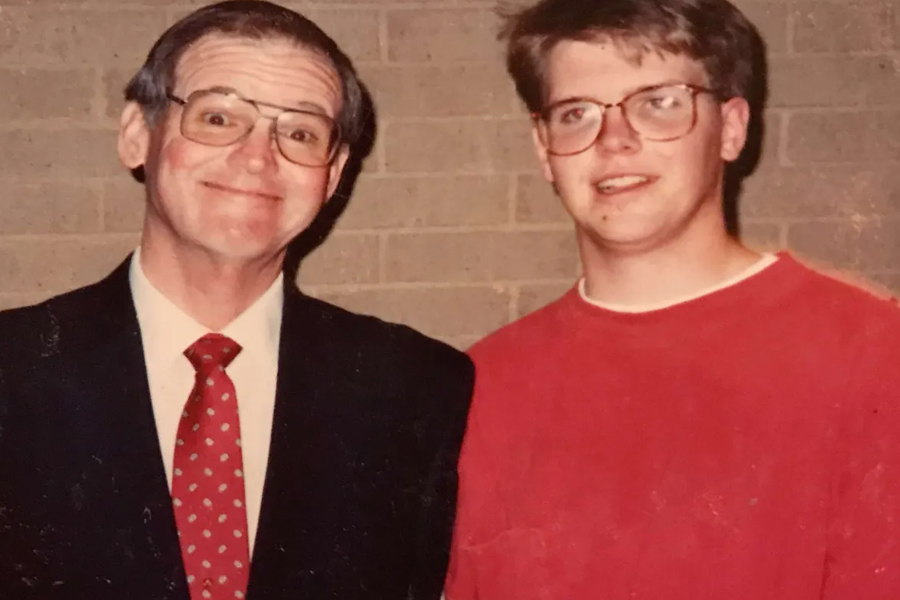
Basic Information
| Field | Detail |
|---|---|
| Full name | Arthur Wesley Millard Jr. |
| Born | November 26, 1942 (Greenville, Hunt County, Texas) |
| Died | November 1991 (records show slight date variations: 11 Nov / 15 Nov) |
| Burial | Forest Park Cemetery, Greenville, Texas |
| Parents | Arthur W. Millard Sr. and Mary Leona Tyler |
| Partner / spouse (in family accounts) | Adele Millard |
| Children | Stephen Millard (older son), Bart Millard (b. 1972) |
| Notable grandchildren | Sam Wesley (grandson; musician and occasional stage collaborator) |
| Occupation (reported) | Local athlete in youth; later worked at construction/traffic sites |
| Major life events (reported) | Serious truck accident → coma (weeks) → personality changes; later reported conversion; died of illness (reported pancreatic cancer) |
| Public profile | Not a public figure; known primarily through the life story of son Bart Millard (lead singer of MercyMe) |
Life, Family & Turning Points
I won’t pretend I knew Arthur — my view of him comes through the radar of other people’s lives, the kind of portrait painted in interviews, family recollections, and a film that turned a private story into a public song. But portraits can be vivid; they can be grainy and cinematic — and Arthur’s reads like one of those slow-shot closeups: a boy from Greenville, Texas, who wore high-school football like a second skin, a man who later stood beside cones and a traffic flag at a work site, and then—suddenly—was the fulcrum of the family’s entire narrative arc.
Here’s the skeleton of what the records and family accounts lay out, lined up so you can see the spine of it in dates and numbers:
| Year / Age | Event |
|---|---|
| 1942 (birth) | Arthur Wesley Millard Jr. born Nov 26 in Greenville, Texas. |
| 1960s (youth) | Local standout athlete — remembered for football prowess. |
| Late 1960s–1970s | Married/partnered with Adele; children Stephen (older) and Bart (1972). |
| c. late 1980s | Reported work accident: hit by a diesel truck while working traffic control; coma for several weeks (accounts mention ~eight weeks). |
| Post-accident | Accounts report a marked personality shift; later became a subject in family conflict and, by some accounts, reconciliation. |
| 1991 (death) | Died in November 1991; illness reported as pancreatic cancer in family narratives. |
If you read this and feel the arc takes on the cadence of a movie — well, it does: the family story became a film that asked big spiritual questions and made a song into a cultural moment. But outside the camera’s glare, Arthur’s life was ordinary and complicated: a working man, a father, a son, a figure who loomed large in the private mythology of his children.
Introducing the Family — the people in the orbit
I like lists — they break down complexity into human-sized pieces. Here’s the family roster and the little introductions that make each name mean something.
| Name | Relation | Short intro |
|---|---|---|
| Adele Millard | Partner / mother of children | The mother who left and later reconciled in family accounts; she is central to the household narrative that shapes her sons. |
| Stephen Millard | Older son | The sometimes-quiet sibling who anchors the family memory — mentioned in family summaries but largely private. |
| Bart Millard | Son (b. 1972) | Lead singer and songwriter of MercyMe; the most public figure in the family and the person whose life-story brought Arthur’s name into broader conversation. |
| Sam Wesley | Grandson | Bart’s son and one of Arthur’s grandchildren; a presence in recent musical moments and a living link across three generations. |
| Arthur W. Millard Sr. & Mary Leona Tyler | Parents of Arthur Jr. | The genealogical roots — the names that appear on memorial records and remind you of continuity across generations. |
When you place those names side by side you see the push-and-pull of family history: sport, work, a catastrophic accident, estrangement, conversion, reconciliation, death. It reads like a triangle of cause and consequence — each vertex a person whose life influenced the others.
The Accident, the Change, and the Song
Here’s the spine of the story that most people know because it became cultural shorthand: Arthur was involved in a severe on-site accident when a diesel truck struck him as he worked traffic control. The family story says he was in a coma for weeks, and that the man who emerged was not the same as the man who’d been there before. Accounts of personality change and subsequent family struggle are part of the same narrative that later produced Bart’s songwriting voice.
That voice — raw, searching, and unusually public for someone from small-town Texas — yielded a song that became a megahit in Christian-pop circles and then, for a time, a mainstream crossover. The film that dramatized elements of the family’s life leaned into that arc: violence and vulnerability, then faith and reconciliation, then the ambiguous ache of a death that marked an end but not an erasure.
I say all this as someone who recognizes the cinematic rhythm of family legend — cause, consequence, redemption — and also as someone who knows that behind every melodramatic beat there’s a tangle of small human details: arguments that never made it into magazine interviews, days when people held their breath without any camera present, and a cemetery plot in Greenville where a name is etched and simple as any ledger.
Career, Money, and the Things That Don’t Get Asked Enough
If you’re hunting for a résumé you’ll strike out fast. Arthur Jr. was not a public figure with a publicly documented net worth, corporate ledger, or celebrity-brand gigs. The accounts say he worked on construction sites and did traffic control at work zones — practical, hands-on labor that doesn’t often make a headline. He had a past as a local athlete; he had a later life defined in family memory rather than columns on a balance sheet.
Net worth? Not on the public record. Career highlight? A small-town football field and, later, the kind of blue-collar job that keeps neighborhoods moving. What matters in the family story is not stock options or job titles but the human consequences of an accident and the ripple effects of personality change.
Why the Story Still Hums
People keep telling this story because it’s about more than one life — it’s about how a child’s memory and a songwriter’s melody can transmute private pain into public art. It’s about the way a single event — a truck, a coma, a few weeks in a hospital — can rearrange a family as surely as an earthquake rearranges a town. And it’s about music, which does what journalism can’t always do: it asks you to feel the thing.
I find myself thinking of the refrain — the idea of imagining the ineffable at the edge of grief — and how pages of ordinary life become lyrics. Arthur’s name lives there: not as a ledger entry but as a shadow at the edge of a chorus, a presence that shaped a son’s songs and a grandson’s stage.
FAQ
Who was Arthur Wesley Millard Jr.?
He was a Greenville, Texas native (born Nov 26, 1942) known in public accounts primarily as the father of musician Bart Millard and for the family story that influenced Bart’s songwriting.
What happened in the reported accident?
Accounts say he was struck by a diesel truck while working traffic control, was in a coma for several weeks, and that the incident preceded major changes in his behavior.
When did Arthur Jr. die and what was the cause?
He died in November 1991 (records show slight date inconsistencies), and family accounts report illness identified as pancreatic cancer.
Who are his immediate family members?
His partner in family accounts was Adele Millard; his children include Stephen and Bart Millard; his grandson Sam Wesley is part of the next generation.
Was Arthur Jr. a public figure with a known net worth?
No; there are no public records documenting a career portfolio or verified net worth—he is known chiefly through family narratives.
Where is he buried?
He is buried at Forest Park Cemetery in Greenville, Texas.