Why Small Pieces Tell Big Stories
Jewelry has been carrying messages for thousands of years, and it still does—quietly, powerfully, every time you clasp a chain or slide on a ring. Ancient rulers layered gold as a shorthand for status and divinity; soldiers wore rings that signaled loyalty and rank. Even in eras when dress codes tried to rein in expression, jewelry slipped past the guard as a subtle form of identity. That legacy lives on. You don’t just wear jewelry; you broadcast a mood, a memory, a claim.
Jewellery is personal and public. It lies against your skin and is visible on your ears, hands, and collarbone. Thus, tiny decisions speak loudest. Your delicate, dramatic, or purposely absent pieces tell the room how to read you.
Earrings: The First Draft of Your Face
Earrings set tone before makeup, before a handshake, before your first word. Simple studs whisper restraint and order. Bold hoops suggest motion, confidence, a readiness to bend rules. Mismatched pairs are a wink—an engineered imbalance that says you’re comfortable with surprise. The right earring can sharpen angles or soften them, widen a frame or tighten it.
History reminds us earrings are stretchy. They’ve been erased and recreated throughout cultures, often with a rebellious edge—think punk spikes, grunge-era safety pins, pearls in mahogany-boarded offices. Your partnership becomes a little, never-neutral footnote as each rebirth changes the rules.
Rings: Personality at Your Fingertips
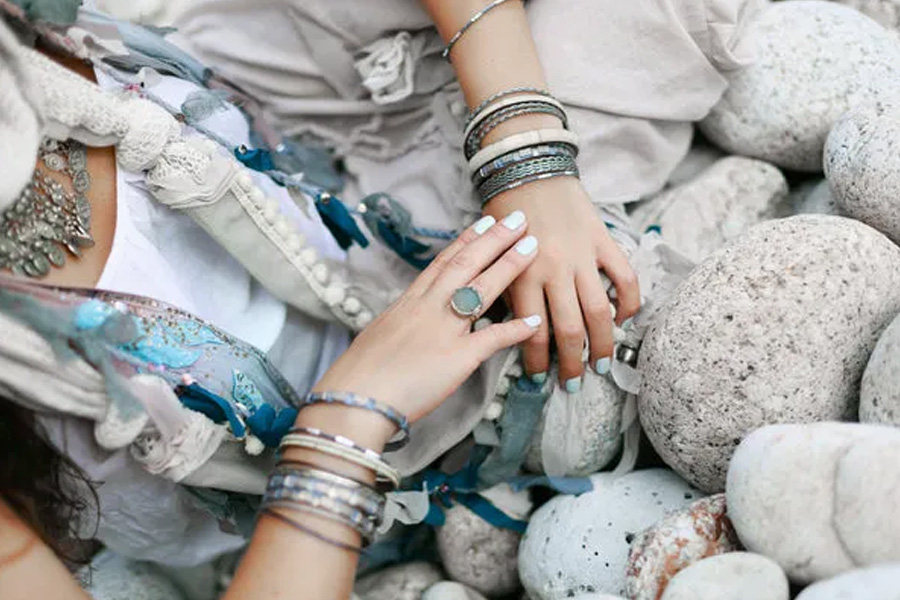
Rings talk with each hand motion. Thin gold bands convey minimalism and clean lines. Big jewels add drama and theatre. Spin a ring unconsciously while waiting or thinking to reveal anxiety and habit. Rings convey your emphasis since they live in gesture choreography.
Anthropologists call rings identity markers for a reason. They can signify status, promise, history, or simply taste. A hand crowded with rings reads differently from a bare one: maximalists telegraph abundance and appetite; minimalists send a steadier pulse. Either way, the message lands before your sentence finishes.
Necklaces: Direction, Framing, Intent
Necklaces are director cues. Long pendants extend the torso and draw attention downward; short chains draw focus to the face. A clean stack of chains suggests curation and sophistication. One statement declares intent without apology. Even your “everyday” necklace plots your desired gaze.
Across time, necklaces carried protection and rite-of-passage energy—charms, amulets, tokens close to the heart. That aura lingers. Today’s pendant might not ward off storms, but it can anchor memory or serve as a signature, the detail people connect with and recall.
Rituals You Wear
Jewellery represents how you prepare to be viewed as well as how you are seen. Attaching an earring or chain is a micro-ritual that calms you before the day begins. Small, symbolic rituals like this boost confidence. Many skip foundation, rush hair, and seek for jewellery since it resets the cadence.
Those seconds matter. They turn chaos into sequence. They’re your private stage directions, invisible to the world but embedded in your posture when you step outside.
Rebellion in the Details
Cultures have sought to control jewellery forever, yet it refuses. Piercings that say “outsider” are increasingly trendy in boardrooms. Pearl shrugs cross gender barriers. Minimalist cuffs whisper disapproval; spike studs shout it. Jewellery allows you test boundaries without burning bridges, signalling change without interrupting dialogue.
What’s compelling here is the range. You can wear a conservative chain and a radical earring, and both feel true. The canvas is one body; the statements can vary by the inch.
Screen-Ready Style
Our first meetings happen on screens now. Clothes get cropped; jewelry holds the frame. Earrings sit center stage on video calls. Rings flash when you type or gesture. Necklaces land perfectly inside a camera’s square. In a world of thumbnails and scrolls, distinct details win the attention economy.
Stylists lean into this: they know balance on-camera is ruthless. A heavy earring can tilt the frame; a bright stud can wake it up. The goal isn’t noise—it’s precision. The right piece makes a face unforgettable in a feed that forgets almost everything.
Your Jewelry Box Is an Archive
Open any jewelry box and you’ll find an edited autobiography. A grandmother’s earrings, a pendant from a city you loved, a ring stamped to mark a turning point. Clothes fade; metal lasts. Jewelry outruns trends and sometimes its owners, traveling with stories lodged in stones and settings.
Independent designers understand this kind of longevity. They craft pieces meant to live with you—age, patina, inherit, return in new forms. The best collections aren’t chasing the week’s mood; they’re building a language you can speak for years.
The Power of Absence
Skipping jewellery alters the message. Bare ears and empty fingers may indicate simplicity, resistance to consumer churn, or a new identity. Absence can be purity, rebellion, or austerity, depending on context. Intention matters. Silence is a sentence.
On Taking Up Space
Minimalism is steady and appealing, but it’s also safe. Statement pieces choose visibility over camouflage. A sculptural earring, a commanding cuff, a necklace that owns the neckline—these pieces take the room without apology. There’s risk in that, which is exactly why it’s thrilling.
Cycles of quiet luxury always return, then boredom sets in, and bold jewelry climbs back onto the stage. People want tools that speak when they don’t feel like talking. Statement jewelry obliges.
Built to Outlast You
Fast fashion frays; metal does not. Bags cave, shoes scuff, fabrics thin. Good jewelry carries weight—financial sometimes, emotional always. A ring can survive centuries and keep a story intact. A brooch can move across generations like a relay baton.
That permanence changes the stakes. When you choose a piece, you’re choosing an artifact, a future heirloom, maybe. It will record your era, your taste, your moments, and keep going when the rest of your closet has retired.
FAQ
Does jewelry really change how people perceive me?
Yes—because it sits at focal points on your body and instantly shapes the frame, balance, and mood of your appearance.
Is it okay to mix metals like gold and silver?
Absolutely; mixed metals look intentional when you repeat each tone at least once across earrings, rings, or a necklace.
How do I choose earrings that work on video calls?
Prioritize pieces that brighten and balance the face—polished studs, medium hoops, or slim drops that don’t pull the frame downward.
What does wearing rings on different fingers signal?
Placement can hint at personality—stacks read curated and lively; a single bold ring reads focused and declarative.
How can I layer necklaces without tangling?
Vary chain lengths and textures, and anchor the stack with a pendant so pieces sit at different intervals rather than competing.
Can statement jewelry work in conservative workplaces?
Yes, if you keep proportions elegant—choose one standout piece and let the rest of your look stay clean and supportive.
What if I prefer not to wear jewelry at all?
That choice still communicates: it reads as minimal, practical, or intentionally unadorned, and can be a strong stylistic stance.
How do I build a collection that lasts?
Invest in timeless silhouettes with solid materials, then add personality through one or two bold signatures you’ll reach for often.