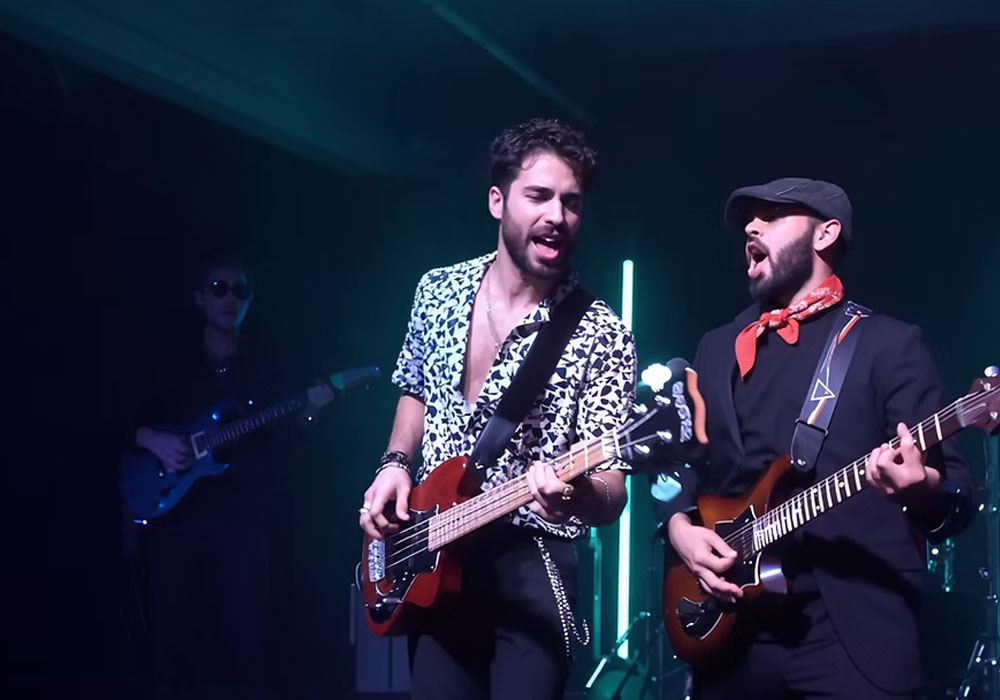
Among teams responsible for corporate events, the question itself is changing shape. Anyone booking a corporate events live band no longer starts from a stark choice between a DJ and a live group, but from a different problem: how to sustain the energy of an evening that moves through profoundly different phases, from the formal remarks to the moment of pure celebration. Galas, product launches and award ceremonies share the same challenge: keeping attention high without breaking the overall tone of the event. It is a quiet shift, but one that is reshaping how corporate planners approach entertainment.
Corporate Events Live Band: Why the Single-Format Choice Is Losing Ground
Companies organizing galas, product launches or milestone events are increasingly moving past the binary choice between a DJ and a live band. Planners report that an isolated live act often struggles to sustain energy across a multi-phase program, from opening remarks all the way to the dance floor, without noticeable dips during the more formal moments. A DJ, for its part, can handle the celebratory stretch of the evening effectively but rarely delivers the same stage presence a keynote or an awards moment calls for.
This is the gap that hybrid DJ and live band entertainment for corporate events fills, a solution built to accompany the entire arc of an event while staying consistent with brand tone and the rhythm of a multi-phase program. Companies such as DLE Event Group, among the first U.S. businesses specializing in this kind of coexistence between live musicians and DJs for the corporate world, build tailored packages around exactly this need for continuity, aligning music with company identity rather than relying on prepackaged solutions.
What Corporate Planners Weigh When Comparing Music Formats
When an events manager compares the options on the table, the criteria guiding the decision rarely stop at budget. The overall energy of the evening matters as much as consistency with brand identity, particularly at occasions where the audience includes clients, partners and executives with different expectations. Timing management becomes an equally decisive factor: a corporate program almost always follows a tight schedule, with slots to respect between networking, speeches and the entertainment itself.
Those organizing this kind of event also weigh the music provider’s ability to adapt, the possibility of adjusting repertoire and volume to the room and the audience in attendance. Flexibility in managing the program often counts for more than the sheer technical quality of the performance, because it is what allows the shift from a formal moment to a more relaxed one without perceptible breaks.
Corporate Events Live Band: Matching the Sound to Company Culture
The musical repertoire of a corporate event cannot be generic. An awards ceremony calls for an elegant register, able to accompany formal moments without feeling intrusive, while a product launch lends itself to a more energetic sound built to generate excitement around the brand. The tone chosen communicates company values as much as the words spoken on stage, and the most attentive planners know this well.
The distinction between formal and informal events also guides the choice of musicians involved: a gala often calls for smaller, more refined formations, while a team celebration leaves more room for energy and direct engagement with the audience. Calibrating style to company culture means avoiding both excessive formality and entertainment so generic it loses touch with the brand’s identity.
Managing Transitions Across a Multi-Part Company Event
A corporate event rarely unfolds in a single moment. Welcome, keynote, dinner and the opening of the dance floor follow one another within a few hours, each carrying its own energy and pace. Managing these transitions without a break in continuity requires a musical direction able to read the program ahead of time, knowing when to lower the volume during a speech and when to raise the intensity to accompany guests onto the floor.
Transition points are often the most delicate: the risk is that too abrupt a shift in atmosphere breaks the engagement built over the course of the evening. A repertoire designed to accompany every phase instead keeps the audience engaged, avoiding dips in attention between the formal block and the more convivial part of the event.
Why Flexibility Is Becoming a Priority Over a Single Format
The fixed format, DJ or band, is losing ground because it cannot meet every need of an event built across multiple phases. Companies organizing annual gatherings, industry galas or networking evenings face an audience diverse in age, role and musical taste, and a single formula rarely satisfies everyone. The ability to adapt in real time becomes a selection criterion more relevant than musical style narrowly defined.
This preference for flexibility also shows up in how providers are chosen: planners tend to favor those who can offer scalable configurations, able to expand or reduce the number of performers on stage depending on the size of the event. A modular approach to entertainment makes it possible to respond to different needs without switching providers for every type of corporate occasion.
A Shifting Standard for Corporate Event Entertainment
Corporate entertainment is going through a quiet but steady transformation. Where the choice was once almost always limited to a DJ or a band, today the event programs of more structured companies integrate tailor-made solutions, able to adapt to every phase of the evening without perceptible interruptions.
This evolution points to a broader shift in priorities: companies are no longer looking for background music alone, but for a genuine direction capable of carrying the event’s narrative from welcome to the final dance. Attention to organizational detail is becoming as much a measure of success as the artistic quality of the musicians involved, a sign of an industry that keeps evolving alongside the expectations of those who plan it.