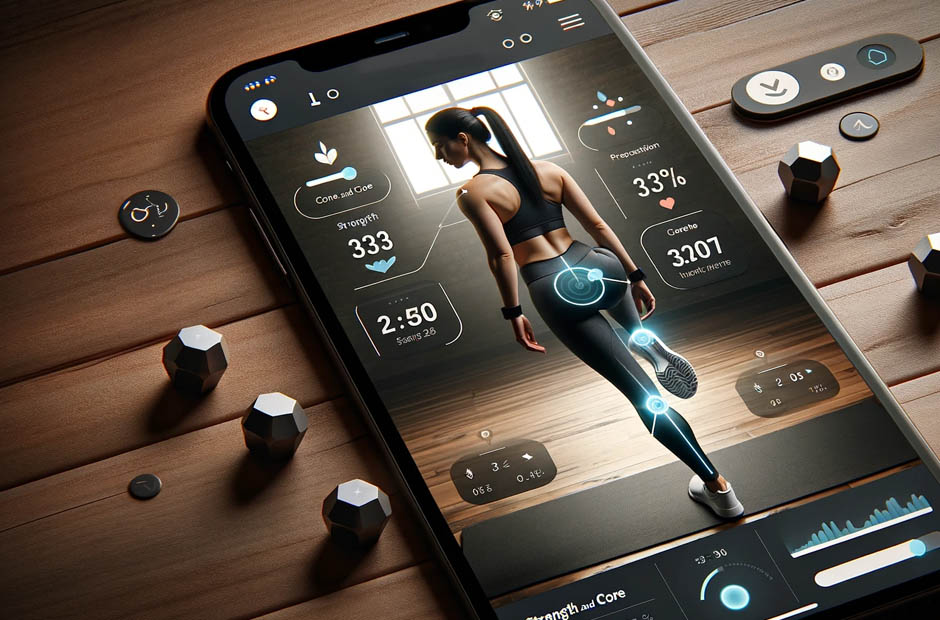
Enterprise health and consumer brands now treat fitness and healthcare apps as revenue platforms. They no longer treat them as engagement experiments. AI now drives personalization, coaching, and retention across digital wellness and healthcare products.
The global fitness app market reached about $10.5 billion in 2024, and analysts expect it to cross $30 billion by 2032. Growth comes from wearable adoption, employer wellness programs, subscription models, and the expansion of connected healthcare apps. North America leads this adoption because of high smartphone usage and strong healthcare spending.
Executives across large enterprises now face a clear problem. Users demand personalized health experiences across both fitness and healthcare apps, but legacy systems cannot process real-time data from wearables or AI models. Engineering teams must deliver scalable AI features while controlling cost, risk, and compliance.
Why Enterprises Invest in AI Fitness Apps
Large organizations build AI fitness apps to solve operational and financial problems. Insurers want better risk models. Employers want lower healthcare costs. Consumer brands want recurring subscription revenue.
Google has integrated AI coaching into Fitbit to deliver personalized recommendations. Garmin has launched a subscription tier built around AI health insights. These moves show a shift toward data-driven wellness services that generate recurring revenue.
Enterprise teams face three consistent challenges:
- Fragmented data from devices, wearables, and health systems
- AI features that fail to drive measurable engagement
- Rising infrastructure costs from real-time analytics
These problems shape both the cost and architecture of AI fitness platforms.
Cost Breakdown: MVP vs Enterprise-Grade Platform
Enterprise teams usually choose between a focused MVP and a full-scale platform. Each path serves a distinct business objective and has a corresponding cost structure.
An AI fitness MVP costs between $80,000 and $180,000. Teams build it to validate engagement, pricing, and retention. The scope stays narrow. The product focuses on one or two primary use cases such as activity tracking, guided workouts, or nutrition coaching. The AI layer often relies on pre-trained models or rule-based recommendations.
MVP builds include core components:
- User onboarding and profile management
- Activity tracking and progress dashboards
- Basic AI workout or nutrition suggestions
- Integration with one wearable ecosystem
- Subscription or enterprise login layer
Engineering teams usually deliver an MVP within three to five months. The architecture supports moderate traffic and limited data complexity. The goal centers on market validation, not long-term scale.
An enterprise-grade AI fitness platform costs between $350,000 and $1.2 million or more. Large organizations require multi-tenant architectures, real-time data pipelines, and strict compliance frameworks. These requirements expand the engineering scope and infrastructure cost.
Enterprise builds include:
- Real-time AI coaching engines
- Multi-device integrations across wearables and health APIs
- Advanced analytics dashboards for employers or insurers
- Compliance-ready infrastructure with encrypted storage
- Role-based access for large user groups
- Scalable cloud architecture for high concurrency
The main cost drivers include AI model development, data ingestion pipelines, security layers, and cloud analytics infrastructure. Enterprise teams must also plan for continuous model updates and long-term maintenance.
Core Features That Define Competitive AI Fitness Apps
Enterprise fitness apps now share a baseline feature set. However, feature depth determines user retention and business impact.
Modern AI fitness platforms focus on personalized guidance powered by real-time activity tracking. The system collects data from smartphones, smartwatches, and connected devices, analyzes activity, sleep, and health signals, and generates adaptive workout and nutrition plans that drive engagement and long-term retention.
Key features that define competitive platforms include:
- AI-driven workout and nutrition plans
- Real-time activity tracking and analytics
- Wearable and IoT device integrations
- Behavioral nudges and habit-formation tools
- Community or social engagement features
- Subscription and enterprise reporting dashboards
Many platforms now integrate computer vision models. These models detect posture and count exercise repetitions using smartphone cameras. This approach reduces dependency on external sensors and expands accessibility.
Enterprise teams should focus on outcome-driven features. Retention, engagement, and subscription metrics should guide roadmap decisions. Feature quantity alone does not guarantee product success.
Recommended Tech Stack for 2026
Engineering leaders in large enterprises prioritize scalability, data integrity, and AI performance. A modular, cloud-native stack supports these goals.
Most AI fitness platforms rely on a modular, cross-platform architecture. Teams use React Native or Flutter to run a single codebase across iOS and Android, which reduces engineering overhead. The backend runs on microservices built with Node.js, Python, or Go to manage user data, activity streams, and analytics. The AI layer sits at the core, where teams use TensorFlow, PyTorch, or managed AI services to build and run recommendation models at scale.
A typical enterprise architecture includes:
- Frontend: React Native or Flutter
- Backend: Node.js, Python, or Go microservices
- AI layer: TensorFlow, PyTorch, or managed AI APIs
- Data pipeline: Kafka, Snowflake, or BigQuery
- Cloud infrastructure: AWS, Azure, or Google Cloud
- Security: OAuth2 authentication, FHIR APIs, encrypted storage
This architecture supports real-time analytics and continuous AI model updates. It also allows integration with wearable devices, health systems, and enterprise dashboards.
Engineering teams should design the data pipeline early. Real-time ingestion, model training, and analytics workflows define long-term scalability. Poor data architecture often leads to rising infrastructure costs and performance issues.
5 Notable AI Fitness App Development Companies Across the USA in 2026
1. GeekyAnts
GeekyAnts is a global technology consulting firm specializing in digital transformation, end-to-end app development, digital product design, and custom software solutions. The company works with enterprise clients across healthcare, fintech, and consumer platforms. Teams focus on scalable architecture, cross-platform engineering, AI-driven experiences, and HIPAA-aligned systems where health data compliance is required. Enterprises engage the firm for MVP launches, platform modernization, and long-term product engineering initiatives.
Clutch Rating: 4.9/5 (111+ verified reviews)
Contact Information:
GeekyAnts Inc., 315 Montgomery Street, 9th & 10th Floors, San Francisco, CA 94104, USA
Phone: +1 845 534 6825 | Email: info@geekyants.com | Website: www.geekyants.com/en-us
2. BairesDev
BairesDev provides nearshore engineering teams to large enterprises. The company delivers scalable backend systems, data platforms, and mobile applications across industries, including healthcare and wellness. Many organizations use their distributed engineering model to accelerate digital programs and reduce hiring cycles.
Clutch Rating: 4.9/5 (62 verified reviews)
Contact Information:
50 California Street, San Francisco, CA, United States 94111
Phone: +1 408 478-2739
3. Intellectsoft
Intellectsoft develops enterprise software and digital platforms. The firm focuses on mobile systems, IoT solutions, and data-driven applications. It works with large organizations that require scalable digital products, complex integrations, and structured transformation programs.
Clutch Rating: 4.9/5 (41 verified reviews)
Contact Information:
78 SW 7th St suite 800, Brickell City Centre, Miami, FL, United States 33130
Phone: +1 650 233-6196
4. BlueLabel
BlueLabel develops mobile and digital platforms for enterprise and high-growth organizations. The firm focuses on consumer apps, connected experiences, and data-driven platforms. Its teams support product strategy, design, and full-cycle development. Large media, fintech, and healthcare brands work with BlueLabel to launch and scale digital products. The company maintains a strong Clutch presence with consistent client feedback on delivery quality and collaboration.
Clutch Rating: 4.8/5 (50+ verified reviews)
Contact Information:
18 West 18th Street, 9th Floor, New York, NY 10011, USA
Phone: +1 888 525 8375
5. DevPie
DevPie specializes in mobile-first healthcare applications with proven expertise in wearable device integration and real-time data processing. The firm brings cost-effectiveness for mid-market organizations without compromising technical rigor.
Clutch Rating: 4.8/5 (2+ verified reviews)
Contact Information:
155 Bovet Road, Suite 201, San Mateo, CA 94402, USA
Phone: +1 650 485 6660
Final Considerations for Enterprise Leaders
AI fitness platforms require strong data pipelines, secure architectures, and measurable outcomes. Many teams underestimate the complexity of real-time AI recommendations and multi-device integration.
A staged approach reduces risk. Teams launch an MVP to validate engagement and revenue assumptions. They scale into a full enterprise platform once metrics prove viable.
Enterprise leaders often start with a short technical consultation. This step helps them map feature priorities, integration scope, and cost ranges before they commit to full development.