A double-girder bridge crane is often chosen when lifting requirements extend beyond occasional use and enter the realm of continuous industrial handling. In facilities like steel fabrication plants, heavy manufacturing shops, mills, warehouses with oversized loads, and large assembly environments, cranes are not accessories—they are production equipment. Heavy-duty performance means the crane can lift large loads repeatedly without drifting out of alignment, losing stability, or suffering accelerated wear. It also means the crane can operate safely under dynamic loads, including rapid starts, controlled stops, and load-swing impacts. Double-girder designs are commonly considered heavy-duty because their structure supports higher loads and longer spans while keeping deflection low. The two-girder bridge also offers improved hoist placement and better force distribution across the runway. Understanding why this design is heavy duty helps buyers focus on long-term durability, not just rated capacity.
How Heavy Duty Is Defined
The Core Benefit of Two Girders
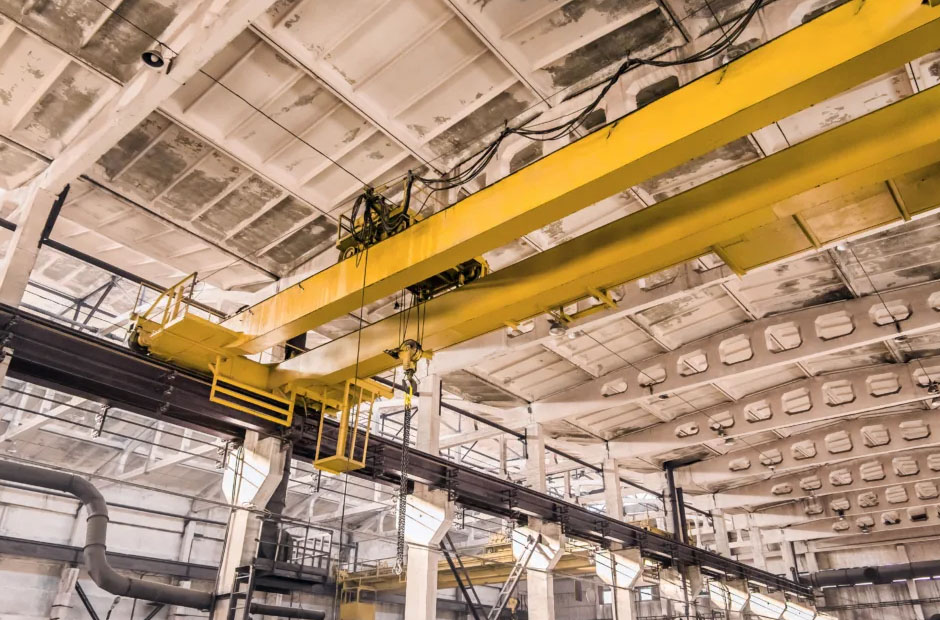
The primary engineering difference between single-girder and double-girder cranes is structural rigidity. A double-girder bridge crane uses two main beams to support the bridge and trolley. This configuration distributes loads over a wider footprint and reduces bending stress. Reducing deflection is important because it keeps the lifting stable, protects wheel alignment, and reduces the vibration that causes fatigue damage. When a crane carries a heavy load, the bridge experiences varying loads, and a stiff structure is necessary to maintain smooth movement. Double-girder bridges also allow the trolley to run on rails mounted on top of both girders, providing better support under high lifting loads. In many industrial operations, the crane must perform thousands of lifts per month, so reducing stress per lift directly improves the crane’s long-term service life.
Hoist Mounting and Load Handling Strength
The hoist and trolley arrangement on a double-girder crane is a major reason these systems are classified as heavy-duty. Double-girder cranes often mount the hoist between the girders, providing additional hook height and supporting larger lifting mechanisms. More importantly, this structure allows stronger hoists with heavy-duty gearboxes, brakes, motors, and rope drums. Hoists in industrial environments must endure heat buildup, repeated load cycles, and high mechanical stress. A heavy-duty system is designed not only to lift the maximum load but also to maintain performance during repeated cycles without failure. This is one reason heavy-duty double-girder bridge cranes are used in operations where daily lifting is continuous and downtime is costly. When hoist design matches high-duty work cycles, lifting becomes stable, repeatable, and safer over the long term.
Strength Is About Repetition
A crane is considered heavy-duty when engineered to lift heavy loads repeatedly without distortion, control loss, or component fatigue. The design supports not only capacity, but consistent long-term performance.
Material Strength and Structural Fatigue Resistance
Heavy duty cranes must resist fatigue because industrial lifting creates cyclical structural stress. Each lift slightly loads and unloads the crane structure, and over time, this can cause fatigue cracks if material thickness, reinforcement placement, or weld quality is insufficient. Double-girder cranes use heavy steel sections, reinforcement at high-stress points, and design geometry that reduces stress concentrations. Weld quality is essential because poor weld penetration or abrupt transitions can cause fatigue failure. Heavy-duty designs also limit torsion and twisting, which reduces uneven stress on the bridge, end trucks, and wheel assemblies. This structural strength allows the crane to maintain alignment even after years of operation. The more a crane is used, the more important fatigue-resistant design becomes because the daily duty cycle affects long-term durability.
Duty Class Ratings and Performance Expectations
Heavy duty is not only defined by tonnage rating. It is also determined by service classification, which captures the number of lifts per hour, average load percentage, and total operating time. A crane used occasionally at low loads may last decades with minimal stress, while a crane used continuously at high loads requires stronger components and design allowances. Double-girder cranes can be designed for higher duty classes because the structure supports heavier hoists, robust travel drives, and components designed for continuous operation. Service classification helps ensure the crane’s mechanical systems are sized correctly. Motors must handle frequent starts. Brakes must manage repeated stops. Gearboxes must resist wear in long travel cycles. Heavy-duty cranes are designed with these requirements in mind, making them better suited for industrial duty cycles.
End Trucks, Wheels, and Runway Load Distribution
The crane’s bridge is only part of the heavy-duty equation. End trucks and wheel assemblies carry the actual rolling load across the runway. Heavy-duty double-girder cranes feature stronger end-truck frames, heavy-duty wheel assemblies, robust bearings, and properly sized axles. These components handle both vertical load and side forces caused by travel and alignment shifts. Wheel loads can become extremely high in heavy-duty applications, and poor wheel design can damage runway rails or cause vibration that spreads wear across the system. Runway alignment and rail condition also matter because a heavy crane moving under load creates dynamic forces. A true heavy-duty crane is designed to roll smoothly with consistent load distribution. This reduces rail wear, extends wheel life, and helps prevent tracking problems that can cause shutdowns or unsafe movement.
Drive Systems and Control Precision Under Load
Heavy duty does not mean harsh motion. In fact, heavy-duty cranes require smoother control to reduce impact stress. Drive systems often include variable-frequency drives (VFDs) that smooth acceleration and braking, minimizing load swings and mechanical shock. Controlled movement extends component life by reducing sudden torque spikes on motors, gearboxes, and wheels. Limit switches, overload protection, travel controls, and braking systems are also designed to operate reliably under repeated cycles. A crane may lift 30 tons, but without stable control, it cannot safely support high-frequency operations. Heavy-duty design delivers both strength and refined control, enabling precise load positioning in production environments.
Heavy Duty Comes From Total System Engineering
A double girder bridge crane is considered heavy-duty because it is engineered for repeated lifting, long travel cycles, and stable load handling under demanding industrial conditions. The two-girder structure reduces deflection, improves trolley support, and distributes forces more effectively across the bridge. Heavy-duty hoists, strong steel construction, fatigue-resistant design, robust end trucks, and durable wheel systems all contribute to long-term reliability. Duty classification and control precision further define whether the crane can truly handle industrial workloads. Heavy-duty is not simply a load rating—it is the ability to perform consistently over years of strain without losing performance, safety, or alignment.