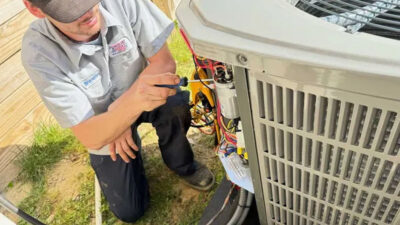
Most HVAC complaints are not complete breakdowns, adds Gregory Property Management, a leading Redmond Management Company. The system powers on, air blows from the vents, and the thermostat appears to be working—yet the home still feels uncomfortable. These are comfort complaints, and they often happen room by room. One bedroom feels too warm, while the living room feels fine. The upstairs is always hotter. A back room stays cold in winter. These issues rarely come from one single cause. They usually involve airflow delivery, duct design, insulation differences, sunlight exposure, room pressure, and return air limitations. HVAC contractors diagnose these problems using a structured process that starts with the homeowner’s experience but quickly shifts into measurement and mapping. Room-by-room diagnosis is important because comfort is not generated by the equipment alone—it is generated where the air actually arrives.
Room-by-Room Diagnosis Approach
Starting With a Comfort Map of the Home
Contractors begin by asking detailed questions about which rooms feel uncomfortable and when the issue is most noticeable. Timing matters because comfort shifts with weather, sun position, and HVAC runtime. A room that overheats in the afternoon may be affected by solar gain through windows. A room that feels cold at night may have insulation deficiencies or duct leakage. Contractors often create a simple “comfort map” by walking the home and identifying complaint zones. They review each room’s layout, vent placement, door position, and return-air access. Even furniture placement can block airflow. During this walkthrough, HVAC contractors observe signs such as closed registers, blocked returns, room-to-room airflow differences, and unusual temperature stratification. This early step narrows the set of likely causes and prevents ad hoc adjustments.
Measuring Supply Air and Return Air by Room
Once the comfort map is established, room-by-room measurement begins. Contractors check the supply air volume and temperature at each register. This helps determine whether a room is receiving sufficient conditioned air and whether the delivered air matches the intended heating or cooling performance. Return air is just as important. A room may receive supply air but still feel uncomfortable if air cannot return to the system properly. Poor return-airflow creates a pressure imbalance, reducing air delivery and causing uneven temperatures. Contractors often test rooms with doors open and closed to see whether airflow changes. Companies such as Evans Heating & Cooling usually emphasize that comfort complaints are frequently airflow complaints in disguise, and that airflow measurement is one of the fastest ways to confirm the cause. This measurement step ensures diagnosis is based on data, not guesses.
Comfort Depends on Air Movement
Room comfort is controlled by how air enters and exits each room. HVAC contractors diagnose issues by checking the performance of the supply, delivery, and return paths, because air must circulate properly for temperature balance.
Checking Duct Pathways and Branch Performance
Room-by-room issues often trace back to duct distribution. Contractors inspect duct branches feeding each room, checking for crushed sections, disconnected joints, loose seals, or poorly supported flex ducts that sag and restrict airflow. Duct leakage is a major cause of uneven comfort because air may be lost into attics, crawlspaces, or wall cavities before reaching certain rooms. Contractors also verify that duct sizing matches each room’s load. A large room with long duct runs may receive insufficient airflow if the ductwork is undersized or poorly balanced. In many homes, duct systems were designed for general operation, not for modern usage patterns such as home offices or converted rooms. Contractors often find that comfort complaints occur in rooms located at the end of long duct runs where airflow naturally weakens.
Evaluating Sun Exposure and Heat Load Differences
Comfort complaints are not always caused by HVAC weakness. Sometimes rooms are simply exposed to more heat load. Contractors evaluate sunlight exposure, window type, curtain use, and room orientation. South-facing rooms often heat up faster. Rooms with large windows may lose heat quickly in winter and gain heat rapidly in summer. Even if airflow is normal, the room may not hold temperature due to heat transfer through the glass and walls. HVAC contractors consider these load differences when diagnosing. They may recommend airflow adjustments, zoning solutions, or duct balancing, but they may also suggest insulation improvements or window management if heat load is the core issue. A room-by-room process ensures the contractor doesn’t treat every complaint as an equipment problem.
Testing for Room Pressure Imbalance
Pressure imbalance is one of the most common hidden causes of room discomfort. If a room receives a strong supply of air but has limited return air access, it can become over-pressurized. This causes air to escape through gaps, pushing conditioned air out of the building envelope. Meanwhile, the rest of the home may become under negative pressure, drawing in hot or cold outside air. Contractors test pressure issues by checking airflow under doors, using pressure meters, and observing how doors behave during HVAC system operation. Rooms that “puf” air outward when doors open often have a pressure imbalance. Solutions may include improving return pathways, adding transfer grilles, undercutting doors, or adjusting duct supply levels. Fixing pressure usually resolves comfort complaints without any equipment changes.
Balancing Airflow and Setting Expectations
After measurements and system checks, contractors adjust and balance airflow. This can include damper adjustments, register tuning, duct repairs, and filter upgrades. The goal is to distribute airflow more evenly so each room receives air closer to its needs. Contractors also explain that perfect uniform temperature in every room is difficult in many homes due to structural and load differences. However, proper diagnosis can reduce extreme differences and improve overall comfort. Room-by-room balancing is effective because it targets each room’s problem rather than applying one system-wide change that may only help some areas.
Room-Level Diagnosis Solves the Real Comfort Problem
HVAC contractors diagnose comfort complaints room by room because discomfort is usually caused by uneven delivery, not total equipment failure. They start by mapping complaints, then measure airflow and temperature in each room, evaluate return pathways, inspect duct branches, and test for pressure imbalance. They also account for heat-load differences due to solar exposure and insulation conditions. This detailed approach allows contractors to correct comfort issues through targeted airflow balancing, duct repairs, and circulation improvements. Room-by-room diagnosis works because it treats comfort as a whole-home distribution problem, ensuring the solution matches what people actually feel inside each space.